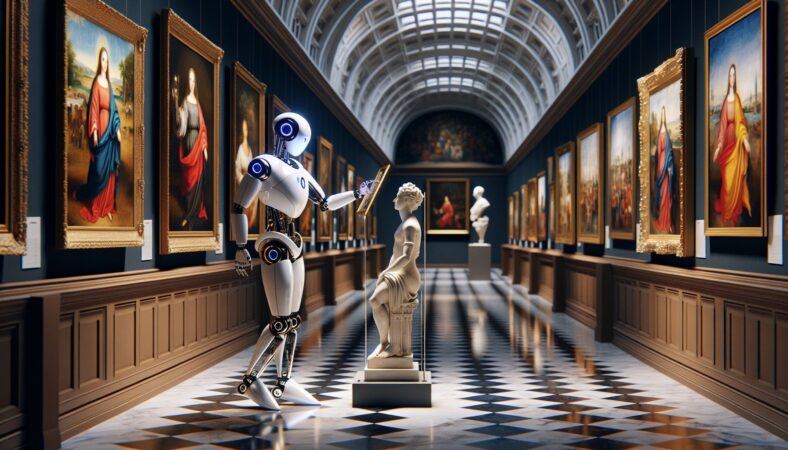
Hey fellow tech enthusiasts! Today, I’m diving into an area where AI has completely changed the game: the creative arts. Yes, you heard it right. The domain traditionally led by the quirky geniuses and creative rebels amongst us is now being disrupted, no, more like transformed, by our mechanical proteges. So, grab a cup of coffee, put on your fanciest code-laden spectacles, and let me take you on this wild journey of artificial creativity.
The Early Days: From Museums to Machines
I still remember my first introduction to AI in the creative realm. It was a hazy college lecture about Harold Cohen and his AI program called AARON. Now, AARON was no Mona Lisa, but it was revolutionary in the ’70s for computer-generated art. Imagine a time when computers were still mostly these hulking pieces of iron. AARON broke new ground, painting bold strokes and challenging the traditional art elite.
Nowadays, when I look at the output of present-day AI art, I can’t help but giggle a bit at the pixelated daubs of colors that seemed so impressive back then. Fast forward to today, we’ve got AI programs like DALL-E and Midjourney making masterpieces that make you go, “Wait, a machine did that?”
Machines Painting a Thousand Words
Modern AI art generation tools have come a long way, creating visuals that are complex, beautiful, and sometimes, unnervingly human. Take OpenAI’s DALL-E, for instance. This little wizard can whip up images from textual descriptions faster than my brain can process the morning caffeine! Be it “a two-headed alien playing poker under a neon moon” or “a vintage train gliding through a rainbow forest,” it’s an artistic Pandora’s box where imagination meets deep learning.
These AI artists aren’t just improving in quality but are also enabling accessibility for those of us who were never destined to hold a paintbrush without resulting chaos. We, the mortals who’ve hesitated before stepping into an art class, can now create visuals that are part Picasso, part programming wizardry.
The Complex Symphony: AI in Music Composition
If you thought AI’s invasion in the arts stopped at visual forms, let me introduce you to AI’s presence in music. We’ve now got AI composing symphonies that even Beethoven might raise an eyebrow, or ear, to. Platforms like OpenAI’s MuseNet and Google’s Magenta are on a mission to craft compositions from classical orchestras to jazzworthy jams.
To me, the beauty here lies not just in composition but in collaboration. Artists and musicians are using AI like a band member who always shows up to practice with fresh ideas. No attitude, no ego, just boundless creativity. It’s the ultimate form of creative partnership.
Bridging the Divide: AI and Literature
For all the wordsmiths out there, have no fear. AI’s got you covered too. GPT-3 has already started penning articles, poems, and even short stories. It is as if Shakespeare’s quill met the processing power of 175 billion parameters. Sure, it might miss the raw emotions of human experience sometimes, like that one time it deduced “banana is a flying bird.” We’ll work on it!
The implications? Writers can explore avenues they’ve never dared before, perhaps co-writing novels with AI, crafting pieces that draw from vast sources of influence. Of course, it poses questions on authorship, but hey, what’s art without a sprinkle of controversy?
The Philosophical Canvas: What It Means for Creativity
All right, let’s pause the tech-hype train for a moment and grapple with a bit of philosophy. What happens when machines match our pace in creativity? Does art lose its essence, or do we redefine art itself? It’s a question that tends to spark deep debate at my favorite hacker coffee shop.
Personally, I view AI not as a replacement but as an enhancement. These tools push the boundaries of what’s possible while leaving the human essence right where it belongs: at the heart. Humans bring inspiration, context, and emotion, while AI can provide infinite textures and combinations to color those ideas.
Future Gazing: Where Do We Go From Here?
Predicting where we’re headed with AI and creative arts is like predicting the next internet meme. Both thrilling and entirely unpredictable. However, some guesses point toward greater personal interactions with AI, perhaps a day where every household has its own personal art bot. AI will also likely enhance augmented reality, bringing art exhibits into our living rooms, or better yet, our smart glasses.
As these frontiers narrow, the biggest challenge will be ensuring that creativity across all contexts remains inclusive and representative, steering clear from biases that may have lingered from historical datasets.
Conclusion: Embrace the Machine Brush
So there we have it, folks. The convergence of AI and the creative arts doesn’t herald the end of an era but the start of an exciting new chapter. As we harness these technologies, together we’ll redefine masterpieces in our constantly changing canvas. I, for one, am excited. Time to go boot up my AI art generator and see how it interprets “cyber utopia at sunset!”
There will always be a place for the curious mind and passionate heart in the world of art, be they human or machine. And who knows, maybe someday we’ll see AI art competing for a place at the Louvre. After all, in the words of Picasso (if he ever worked with AI), “Everything you can imagine is real.” Let’s capture it all with 1s and 0s.