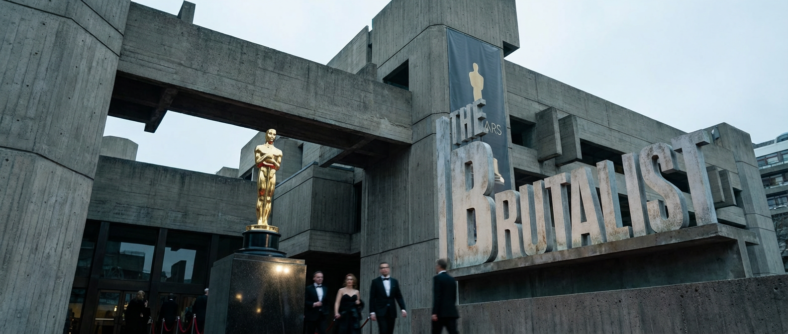
A Three-Hour Monument to Getting It Right
Brady Corbet’s The Brutalist didn’t just win at the 2025 Oscars. It won decisively, claiming Best Picture, Best Actor for Adrien Brody, and Best Director in a sweep that felt almost defiant in its commitment to difficulty. Three and a half hours. Shot in 70mm VistaVision, a format so technically demanding it hadn’t been used for a wide theatrical release since the 1960s. The film showed up to Hollywood’s biggest party like an imposing concrete structure refusing to apologize for its mass, and the industry handed it the crown anyway.
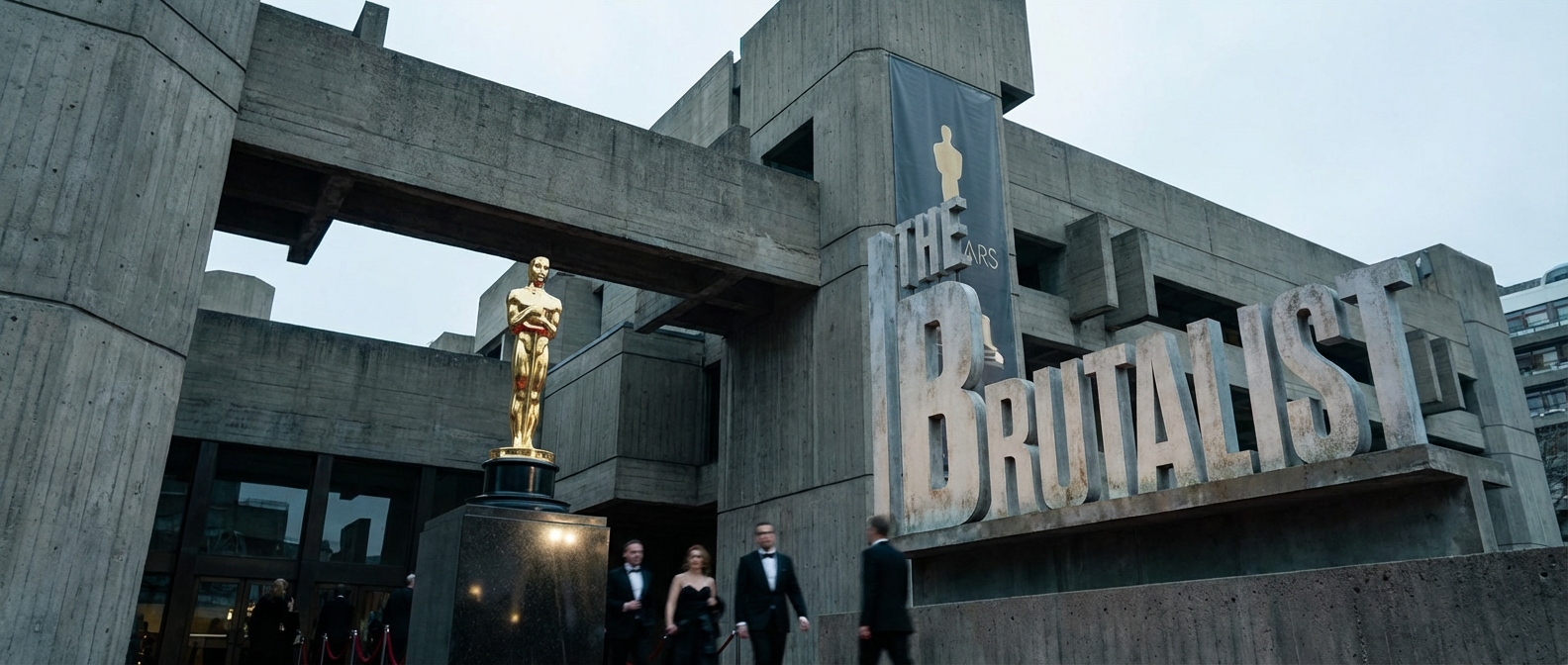
This matters because mainstream cinema acknowledged that architecture, real and uncompromising architecture, could be the emotional spine of a story. Not the backdrop. Not the aesthetic flourish. The subject itself. Corbet understood what many filmmakers never grasp: that built space shapes us, contains us, and sometimes demands to be reckoned with.
The Searches Began Almost Immediately
The day after the ceremony, something remarkable happened. Google Trends recorded a 3,800% spike in searches for “Brutalist architecture” and “what is Brutalism.” Wikipedia’s Brutalism page received over 2.1 million visits in a single week. Think about that number. Two million people woke up after the Oscars and decided they needed to understand what Brutalism actually was.
This is the strange gift that mainstream media attention sometimes gives: sudden, massive curiosity from people who had no framework for the conversation before. They weren’t architecture students or preservation advocates. They were people who watched a movie, got curious, and went searching. Some of them will disappear after a week of Wikipedia rabbit holes. Others might become the advocates and donors who reshape how we think about building preservation in this country.
The real institutions noticed too. Docomomo International, the preservation nonprofit dedicated to modernist architecture, reported a 40% increase in donations in January and February 2025. Direct attribution: the film’s cultural visibility. Money followed curiosity. Preservation budgets shifted. That’s the material consequence of having your subject matter suddenly matter to millions of people.
But Let’s Talk About What Corbet Got Wrong
Here’s where it gets interesting, and where I have to admit the film plays a bit fast and loose with historical accuracy. Architectural historians were quick to point out the liberties taken in depicting Brutalism as a movement. The real movement peaked between 1950 and 1975. It gave us Boston City Hall (1968), that fortress of a building that looks like it could survive the apocalypse. It gave us the Barbican Centre in London (1969), all interlocking concrete geometries and skywalks connecting a whole community vertically.
These buildings were neither accidents nor metaphors. They came from specific historical conditions: postwar optimism about what modernism could achieve, genuine belief in public space, conviction that architecture could shape better societies. Corbet’s film uses Brutalism more as aesthetic and emotional language than as historical document. The liberties matter. They also don’t matter as much as you might think.
Here’s why: if the price of getting three million people to care about modernist architecture preservation is that a filmmaker took some chronological shortcuts, that might be a transaction worth making. Films aren’t textbooks. They’re invitations. And the invitations worked.
The Format Was the Message
The technical choices were inseparable from the subject. Corbet didn’t just make a film about Brutalist architecture. He made a Brutalist film. The 70mm VistaVision format creates massive, immersive visual fields. There’s no escape from the image. You’re inside it. The width and depth and scale become physical experiences rather than aesthetic ones. Watching concrete monoliths and geometric forms expand across that kind of screen isn’t comfortable. It’s not supposed to be. That discomfort is the point.
The runtime works the same way. Three and a half hours refuses the convenience of the two-hour narrative structure. It says: sit. Be present. Let the space and time reshape you. That’s what Brutalist buildings do to the people who move through them. They insist on a different pace, a different awareness of mass and material and shadow. The film’s form mirrors its subject in ways that most cinema never achieves.
What Happens to All This Attention?
The real question is whether this moment sticks. Will the 3,800% spike in searches translate into sustained interest? Will the donation surge to preservation organizations create actual change in how we protect modernist landmarks?
Maybe. The history of cultural moments like this is unpredictable. But something has shifted. Millions of people now have a reference point for Brutalism that didn’t exist before February 2025. They know the name. They’ve seen buildings. They understand that concrete and geometry and unapologetic scale can be beautiful without ornament or decoration. Some of them will visit Boston City Hall or the Barbican or any of the other monuments from that postwar era. Some will become advocates. Some will simply carry a new appreciation forward quietly, noticing buildings differently.
That’s not nothing. That’s actually how cultural shifts happen. A film wins. People get curious. Wikipedia gets crowded. Money flows toward preservation. The buildings register a little more strongly in our collective consciousness. The conversation continues, and if you’ve noticed the shift in how architecture is being discussed since that Oscar ceremony, you know that part has already started. What do you think will happen next?