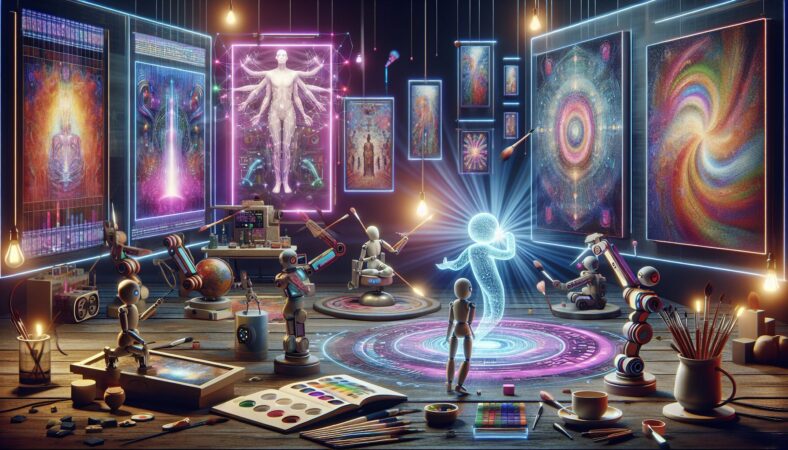
Hey fellow tech aficionados! Today, I’m jumping into a topic that might just be my personal favorite playground in the world of emerging tech—the weird and wonderful fusion of Artificial Intelligence and the creative arts. If you’re anything like me, you get a kick out of watching machines do things we once thought were purely human territory, like composing music or painting canvases. So, let’s take a walk down innovation lane and explore how AI is not just enhancing, but completely flipping our creative world upside down.
The Birth of AI Artistry
First things first, if you’re under the impression that art still exclusively belongs to the human realm, let’s set that record straight. AI has come a long way from understanding linear algebra on steroids. We’re talking about neural networks now flexing their muscles in ways Vincent van Gogh probably never imagined (though wouldn’t he just love it?). From generating genuinely impressive visual art to crafting music that can evoke deep emotions, AI is broadening the creative spectrum like never before.
Generative Adversarial Networks: The Picasso of AI
At the heart of this creativity surge is our buddy, the GAN—or Generative Adversarial Network, for those who don’t speak fluent tech acronym. It sounds fancy because it is. Picture this: two neural networks playing a never-ending game of cat and mouse. One generates images; the other evaluates them. The result? An iterative feedback loop that produces art so genuine, it can sometimes fool our very human eyes.
GANs have been used to create everything from surrealistic landscapes to lifelike portraits. Remember that one time a GAN-generated artwork was auctioned for a cool $432,500? That’s not just a fluke; it shows just how seriously people are taking AI’s capability and future commercial potential in the arts.
AI, the Music Maestro
Let’s shift gears to music. AI is jamming—and I mean really getting into the groove. Tools like OpenAI’s MuseNet and Google’s Magenta project are crafting compositions that range from classical symphonies to pop ballads. These platforms don’t just mimic existing styles; they blend influences, creating something novel each time.
A New Collaborative Tool
Though AI can produce solos worthy of a standing ovation, let’s not forget its value as a creative partner. Musicians are increasingly using AI to overcome creative blocks—AI suggests novel chord progressions or melodies that might never have crossed the human composer’s mind. Imagine the Beatles’ “Hey Jude” infused with a touch of Tchaikovsky. Wild, right?
There’s a bit of fun to be had in the unpredictability too. AI’s lack of preconception means it sometimes spits out a musical gem that’s nothing like what we expect, often challenging artists to rethink their own notions of harmony and rhythm.
The Writer’s New Muse
Now, I can’t touch on creative AI without shouting out its growing role in writing. No, I’m not talking about robo-journalists churning out today’s news snippets (though that’s happening too). I’m talking about AI co-authors, those quiet companions virtually assisting writers in creating both fiction and factual prose.
Tools like GPT-4 have become secret co-writers, helping craft narratives that take readers on unexpected journeys. Horror stories, mystery plots, you name it—AI’s helping authors push beyond the realms of predictable tropes and boring clichés.
The Philosophical Quandary: Art for Whose Sake?
But let’s not pretend it’s all sunshine and rainbows. The rise of AI in art does spark some mind-bending questions: What defines creativity? Can algorithms “feel” art? And should machines ever truly own the creations they help bring to life?
For purists, the notion of a non-human entity becoming an artist is borderline heresy. But maybe it’s not about replacing human creativity; perhaps it’s about augmenting and expanding it. Just as every artist builds on the work of their predecessors, AI can be another layer to this creative mix.
Peering into the Crystal Ball
If you ask me to speculate (and I’m no Nostradamus, mind you), I’d say we’re on the brink of an era where full-fledged artworks will be born out of harmonious human-AI collaborations. The upside? Creative industries could flourish, accessibility might widen, and who knows? The next Da Vinci might just be a collective of human designers and an AI program. Say goodbye to “starving artist” stereotypes.
One thing’s for sure: this techno-artistic evolution isn’t slowing down anytime soon. Whether you’re a traditionalist or an early adopter, the dance between artificial and natural creativity is one worth watching.
Back to You
So, what do you think? Are we watching the start of a new Renaissance powered by silicon-based minds? Or is this just another overblown tech trend that’ll fizzle out? I’m itching to hear your thoughts and reactions to AI in the arts. Until next time, keep an open mind and a playful curiosity—you never know where the next spark of creativity might come from.