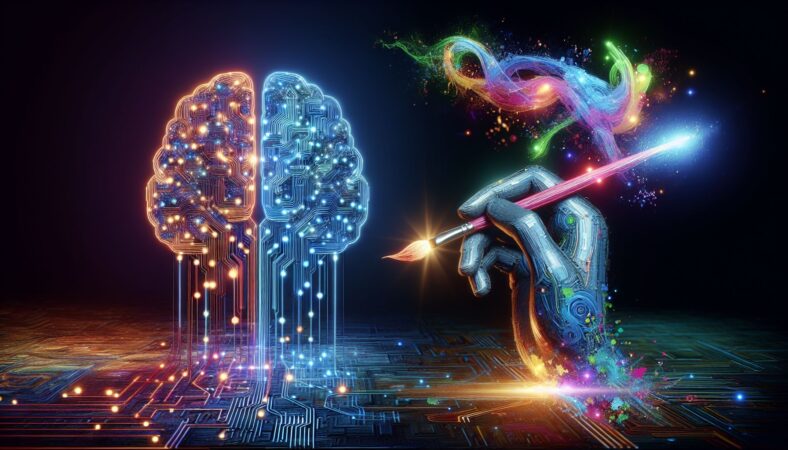
Ah, the sweet, messy world of technology. It’s an age where algorithms and art flirt shamelessly, crossing traditional boundaries and opening up weird new possibilities. Today, I want to take you on a wild ride into a topic that’s been buzzing louder than a million bees high on AI-driven nectar: the incredible fusion of Artificial Intelligence and creative expression.
The Rise of AI in the Creative World
Picture this: A world where machines craft symphonies, scripts, and paintings. Sounds like something out of a sci-fi novel, right? Well, we’re living it. The union of AI and creativity is no longer a futuristic fantasy. It’s here, and it’s shaking up the very core of how we define art.
Unlike decades past, where creativity was a sanctuary strictly guarded by human sentiment, today machines share that space. From OpenAI’s GPT-3, crafting poetry that’s almost human (if not more so), to AI-driven art overnight sensation DALL-E, the possibilities for creativity have exploded.
This isn’t just painting by numbers. We’re talking about machines that interpret style, understand humor, and can pull the emotional strings of an audience. So how did we get here, and what does it mean for the future?
A Detour Through History: From Rule-Based Systems to Neural Networks
To really appreciate this weird symbiosis, we need to look back a bit. Initially, AI systems were essentially fancy calculators, executing rule-based logic with stiff accuracy yet a distinct lack of flair. Creativity, being inherently fluid and subjective, was incompatible with such rigidity.
Enter neural networks—a game-changer. These complex systems, with the ability to learn and adapt, propelled AI into realms once thought inaccessible. By mimicking the human brain, neural networks have allowed us to develop deep learning models that can analyze and generate art with staggering sophistication.
Think of AI’s creative evolution like this: it’s somewhat like teaching a toddler to paint. Given enough time, exposure, and encouragement, you’re bound to disturb an inner Picasso, albeit with slightly more binary opinions.
The Canvas Expands: AI-Generated Art and Writing
Now let’s zoom in on how artificial intelligence has been revolutionizing art and writing. DALL-E, born from the minds at OpenAI, is an AI system capable of creating images from textual descriptions. You want a high-resolution picture of a two-headed flamingo skateboarding in the sunset? Consider it done. It’s like a digital trippy Willy Wonka factory, churning out fantastical visuals.
Similarly, on the writing front, tools like GPT-3 (soon to be shadowed by GPT-4?) are crafting prose with playful poetry and complex narratives. Blogger at heart, you can feed it a few words, and voila—a coherent blog post emerges, eerily reflecting your own style. AI isn’t just following human creativity; it’s becoming a partner in our creative dance.
Breaking the Fourth Wall: The Implications for Creatives
As with any huge shift, the fusion of AI and creativity cuts both ways. For creatives, it brings both exciting opportunities and scary challenges. On one hand, AI tools can significantly streamline creative processes, allowing artists, writers, and musicians to push the boundaries further than ever before.
Consider the limitless possibilities for artists who can use AI to generate inspiration on-demand or writers who can fight creative blocks by turning to their mechanical muse. The boundary between muse and creator blurs, opening endless avenues for expression.
But with great power comes the inevitable identity crisis. Questions of authenticity and originality hover around AI-generated content. Is it real art if there’s no struggle in its birth? Is the machine the creator, or are the developers the true artists? And, notably, where does this leave human creators?
These questions spark fiery debates across circles of artists and technologists alike, with detractors contending that AI threatens to devalue human creativity—collapsing unique styles into algorithmic predictability. Yet, for optimists, AI is a renaissance, not a rival.
Future Trends: What’s Next in AI-Driven Creativity?
Looking ahead, it’s clear the end is nowhere in sight. AI will only continue its march into creative territories, learning complex nuances of what it means to be human.
Virtual reality environments powered by AI, interactive stories that shift with user input, and custom-tailored artworks are just a few tantalizing prospects. And think of collaborative creative spaces—human artists working alongside AI models to co-author books, compose scores, or stage symphonies.
AI could hold the brush for your next great masterpiece, freeing you to dream even bigger, focus on elements that truly ignite your passion, or simply admire the mind-bending art born from this synergy.
Conclusion: The Beautiful Imperfection of a Techno-Utopian Future
If one takeaway emerges from this techno-utopian exploration, it’s that the convergence of AI and creative expression means both an end and a new beginning. An end to the notion of creativity as a purely human affair, and a new dawn for broader, unimagined expressions of art facilitated by our silicon-centric allies.
Rather than fear this AI-powered future, embrace its beautifully imperfect potential. Delight in the fusions no singular mind might conceive alone. In this irresistible mix of algorithm and artistry, we might just find a richer, more varied world of creative expression—one that mirrors the wonders and foibles of humanity itself.
So go ahead, hand your canvas over to AI, and let’s see where this journey into the creative unknown leads us. With every line, brushstroke, and stanza crafted together, we may discover the true essence of a harmonious future—one where creativity knows no bounds.
Until next time, keep imagining, keep creating, and stay curious. The singularity is here, and it’s splashed with all the colors of the digital rainbow.