Reading the Secret Code of Sacred Art
Walk into any museum’s religious art wing and you’re stepping into a visual conversation that spans millennia. That golden halo isn’t just decorative flair. The lamb in the corner? It’s not there because the artist needed to fill space. Religious artwork operates as an elaborate symbolic language, one that artists have been refining and reinventing for over two thousand years.
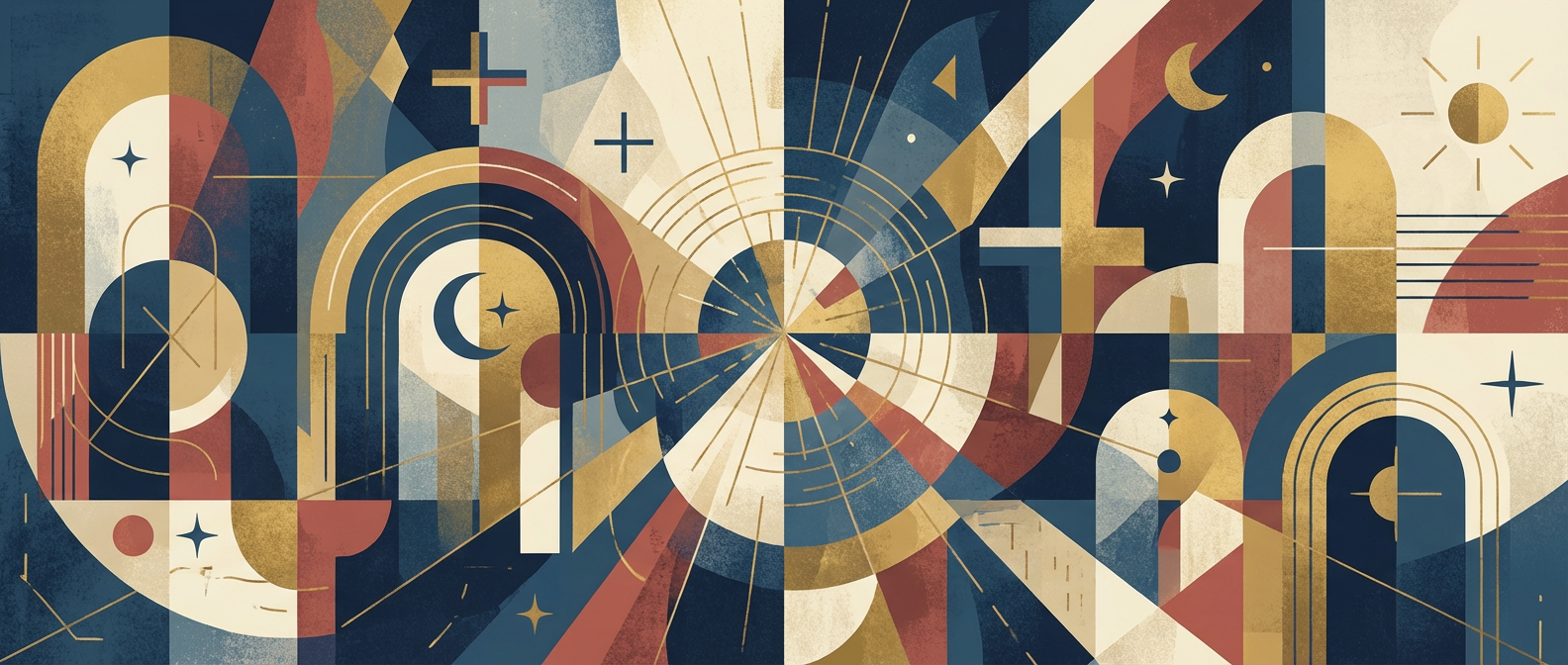
What makes this visual vocabulary so fascinating is how it travels across cultures and centuries, morphs through different artistic movements, yet maintains its core meaning. A Byzantine icon painter in 6th-century Constantinople and a contemporary street artist in Mexico City might use wildly different techniques, but both understand that certain symbols carry divine weight. The tricky part for us modern viewers is learning to read these encoded messages.
Think of religious symbolism as the ultimate insider knowledge. Medieval congregations could “read” a cathedral’s stained glass windows like we read Instagram stories today. They knew that blue meant heavenly truth, that a peacock represented resurrection, that the number three pointed to the Trinity. This wasn’t esoteric knowledge reserved for scholars. It was the visual language of daily spiritual life.
When Colors Carry Divine Messages
Color in religious art isn’t arbitrary. It’s theology made visible. Byzantine artists developed an entire chromatic theology where gold represented divine light, blue signified heaven, and red embodied both divine love and sacrifice. These weren’t suggestions. They were rules as strict as any liturgical text.
But here’s where it gets interesting: different traditions developed their own color vocabularies that sometimes clash beautifully. In Eastern Orthodox iconography, Christ’s robes combine deep red and blue to show his dual nature, fully human and fully divine. Meanwhile, Renaissance painters in Italy often dressed Mary in blue and white to emphasize her purity and connection to heaven. Same symbol system, different cultural emphasis.
Contemporary religious artists play with these inherited meanings in provocative ways. Take Kehinde Wiley’s recent church commissions, where he maintains traditional compositional structures but floods them with patterns and colors that speak to different cultural experiences of the divine. The symbolic language remains recognizable, but it’s been translated into new dialects.
Animals as Spiritual Messengers
Religious art turns the natural world into a spiritual bestiary. Every creature carries symbolic weight, and artists have been deploying this zoological vocabulary for centuries. The lamb represents Christ’s sacrifice, but it also appears in Islamic miniatures representing spiritual submission. Doves flutter through Christian, Jewish, and Islamic artwork as messengers of divine peace.
The really interesting tension emerges when you compare how different traditions use the same animals. Lions appear throughout religious art, but their meanings shift dramatically. In Christian contexts, they can represent both Christ’s resurrection power and Satan’s destructive force, depending entirely on context and accompanying symbols. Buddhist and Hindu art uses lions to represent protective spiritual power, while Islamic calligraphy incorporates stylized lions as symbols of Ali’s courage.
Modern religious artists often subvert these traditional animal symbols or introduce new ones. Aboriginal Australian artists incorporate traditional Dreamtime animals into Christian narrative paintings, creating hybrid symbolic systems that honor both ancestral and Christian spirituality. These works challenge viewers to expand their symbolic vocabulary beyond European traditions.
Geometric Patterns as Sacred Mathematics
Geometry in religious art isn’t just about creating pleasing compositions. It’s about making abstract theological concepts visible. Islamic geometric patterns reflect the infinite nature of Allah through endlessly repeating designs that have no clear beginning or end. Gothic cathedral architects used mathematical proportions they believed reflected divine harmony, creating spaces where the building itself became a prayer.
The circle appears across virtually every religious tradition as a symbol of divine perfection and eternity. But notice how different cultures deploy circular symbolism. Byzantine halos create perfect circles around holy figures’ heads. Tibetan Buddhist mandalas use circular compositions to represent the universe’s spiritual structure. Native American medicine wheels organize ceremonial space in sacred circles.
Contemporary artists continue exploring sacred geometry, but often with a critical edge. Anselm Kiefer’s massive installations use traditional Christian symbolic structures while incorporating materials like ash and lead that reference historical trauma. His work asks whether traditional sacred symbols can still carry meaning after centuries of religious conflict and cultural upheaval.
The Persistence of Sacred Symbols in Secular Spaces
Religious symbolism doesn’t stay confined to churches and temples. It migrates into secular art, advertising, and popular culture, often carrying residual spiritual power even when removed from explicitly religious contexts. Think about how often contemporary artists reference classical religious compositions. The pietà pose shows up in war photography, crucifixion imagery appears in protest art, mandala patterns surface in abstract painting.
Street art offers particularly rich territory for symbolic migration. Muralists worldwide incorporate religious iconography that speaks to their communities’ spiritual traditions while addressing contemporary social issues. A mural might combine Virgin of Guadalupe imagery with Aztec symbols and modern protest slogans, creating layered meaning systems that traditional religious art couldn’t accommodate.
This symbolic borrowing creates productive tension. When Damien Hirst creates diamond-encrusted skulls or crucifixion sculptures, he’s not just being provocative. He’s testing whether traditional religious symbols retain power in secular contexts. The viewer’s discomfort often reveals how deeply these symbolic systems still operate in our collective unconscious.
The next time you encounter religious artwork, try reading it like a detective story. What symbols can you identify? How do they relate to each other within the composition? Are there elements that seem to break traditional symbolic rules? These visual conversations have been happening for millennia, and learning their language opens up entire worlds of meaning hiding in plain sight. I wonder what symbols contemporary artists are creating for future generations to decode.