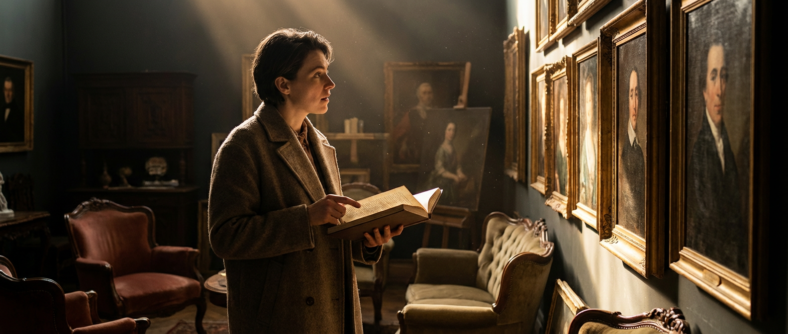
The Weight of a Gaze
Every portrait painting is an obituary written in oils and pigments. Not because the subject is dead, but because it captures a moment that will never exist again. The light falling across Johannes Vermeer’s “Girl with a Pearl Earring” froze a fleeting glance sometime around 1665. That turn of the head, that particular quality of attention? It’s gone forever, except here on canvas.
When you stand before Hans Holbein the Younger’s portrait of Anne of Cleves, you’re looking at more than Henry VIII’s fourth wife. You’re witnessing the remnants of a diplomatic negotiation, a marriage contract painted in careful detail. Notice how Holbein renders every fold of her elaborate German dress, every jewel in her headdress. This isn’t vanity. It’s evidence. The painting was a marriage proposal across borders, carrying messages about wealth, status, and political alliance in each precisely rendered thread.
The obituary quality isn’t morbid. It’s preservation. These paintings work like time capsules, holding entire worlds of meaning that would otherwise dissolve into historical footnotes.

Reading Between the Brushstrokes
Look at John Singer Sargent’s “Madame X” and you’ll see scandal crystallized in paint. That fallen dress strap, which Sargent later painted back into place, caused such an uproar at the 1884 Paris Salon that both artist and subject became social outcasts. The painting reads like a society page from a newspaper that no longer exists.
Sargent’s brushwork tells its own story. Those confident, sweeping strokes across the black dress weren’t just technical choices. They were acts of defiance. While his contemporaries labored over smooth, invisible brushwork, Sargent let his technique show. Each visible brushstroke was a small rebellion against academic convention, a preview of the artistic revolutions to come.
The same rebellious spirit appears across centuries. When Alice Neel painted pregnant women and working-class families in the 1960s, she was writing obituaries for the art world’s obsession with abstract expressionism. Her unflinching portraits of real people in unglamorous moments preserved stories that the galleries weren’t ready to hear.
The Democracy of Memory
Portrait painting democratized immortality long before photography existed. Jan van Eyck’s “The Arnolfini Portrait” doesn’t just show a wealthy merchant and his wife. It documents the rise of a new middle class in 15th-century Bruges. That convex mirror in the background reflects two additional figures, likely witnesses to whatever ceremony we’re observing. Van Eyck signed the painting “Johannes de eyck fuit hic 1434″—Jan van Eyck was here—making himself a witness to history.
The objects scattered through the room tell stories too. The single lit candle in the chandelier might symbolize the presence of the divine. The little dog represents fidelity. The woman’s green dress speaks to prosperity and possibly pregnancy. Each element works like a sentence in a carefully composed biography, written in the visual language of its time.
Even formal court portraits, seemingly stiff and ceremonial, preserve unexpected intimacy. Look closely at Anthony van Dyck’s portraits of King Charles I. Beneath the imperial posturing, you can sense the melancholy that would define this doomed monarch’s reign. Van Dyck painted what he saw: a man trying to inhabit the role of divine kingship while possessing a sensitive, artistic temperament.
The Unvarnished Truth
The most powerful portrait paintings refuse to sanitize their subjects. Lucian Freud’s later works read like unflinching obituaries of the human body itself. His portrait of Queen Elizabeth II from 2001 sparked controversy because it showed the monarch as mortal. Lines, gravity, and all. Freud painted what time does to faces, creating a kind of visual memoir of aging that formal photography wouldn’t dare attempt.
Francisco Goya’s late portraits push this honesty even further. His painting of the Spanish royal family, “Charles IV of Spain and His Family,” appears to be conventional court flattery. Look closer and you’ll see Goya’s subtle savagery. The king appears weak and foolish. The queen dominates the composition with predatory energy. The children seem pampered and vacant. This isn’t celebration—it’s barely concealed critique painted in royal colors.
Contemporary artists continue this tradition of uncomfortable truth-telling. Kehinde Wiley’s portraits of young Black men in poses borrowed from classical European paintings rewrite art history in real time. When he paints a man from the South Side of Chicago in the same pose as Napoleon crossing the Alps, he’s writing an obituary for the exclusion of Black bodies from traditional portraiture while celebrating their rightful place in art history.
The Living Archive
Portrait paintings preserve more than individual lives. They document entire civilizations’ ideas about identity, power, and beauty. The Egyptian Fayum portraits from the first century AD show us Roman Egypt’s multicultural reality in pigment and encaustic wax. These faces, painted to accompany mummies, retain such lifelike immediacy that they collapse two millennia into nothing.
Medieval portrait manuscripts reveal how different cultures understood the relationship between individual identity and divine purpose. Islamic miniature paintings often show rulers and scholars in gardens that symbolize paradise on earth. Their faces may be idealized, but their clothing, architecture, and symbolic objects preserve precise details of courtly life.
The tradition continues in unexpected places. Chuck Close’s enormous pixelated portraits use photography and painting techniques to explore how we construct identity in a digital age. Each tiny square of color works like a pixel, building recognizable faces from abstract components. These works read like obituaries for traditional portrait painting while proving its enduring relevance.
Next time you encounter a portrait painting, resist the urge to simply identify who’s depicted. Instead, read the visual obituary the artist has written. Notice the light, the objects, the pose, the brushwork. Ask what story this preservation tells about its time, its subject, and its maker. You’ll find that these painted lives continue speaking long after their voices have gone quiet.